
Music Charts for Worship Musicians — A Complete Guide
If you’ve played on a worship team for any length of time, you’ve encountered at least one of these: a chord chart, a Nashville Number chart, maybe a rhythm chart. Most musicians use whatever they’re handed without thinking much about the options.
But understanding the landscape of worship musician music charts — what each one is, what it does well, and where it falls short — makes you a better musician and a more informed member of your team.
Here’s an honest look at each one.
Chord Charts — Where Most of Us Start
A chord chart is the most common chart type in worship music. It shows you the song’s lyrics with chord symbols placed above them, giving you a rough sense of where the chords fall.
For a song you already know well, a chord chart is a decent cheat sheet. It jogs your memory, keeps you oriented in the structure, and reminds you of the chord sequence. For that purpose, it works fine.
But if you don’t know the song, it falls short quickly. Without timing information, without rhythmic precision, without the exact placement of chord changes, a chord chart leaves too much to guesswork. You’re essentially being handed a map with no roads on it.
The ceiling of a chord chart is this: it tells you what to play. It doesn’t tell you when.
Lead Sheets — More Informative, Not Ideal
A lead sheet takes the chord chart one step further by adding the melody line — the actual notes of the vocal part, written out in standard notation above the chords and lyrics.
To be fair, the melody notation does offer more timing precision than a chord chart alone. You can infer roughly where the beats fall by following the melody line. But for most worship band musicians, that added clarity still could be improved.
Guitarists don’t need the melody notated. Bass players don’t need it. Keyboard players comping chords don’t need it. Even vocalists typically learn the melody by ear rather than reading it off a page. The melody line adds visual clutter for the majority of the band while still leaving rhythm and chord timing open to interpretation.
Lead sheets are indeed more informative than simple chord charts. A lead sheet moves the needle — just not far enough.
The Nashville Number System — Professional Shorthand
The Nashville Number System is a different animal entirely. Instead of writing out chord names, it assigns numbers to each chord based on its position in the scale. The I chord, the IV chord, the V chord — any musician who knows their intervals can translate those numbers to actual chords in any key, instantly.
That key-agnostic quality is the Nashville Number System’s greatest strength. A Nashville chart works in any key without rewriting. If your worship leader decides to drop the song a half step at the last minute, no problem — the numbers don’t change. It’s genuine professional shorthand, widely used in Nashville recording sessions and in worship contexts around the country.
For simple, straightforward songs with experienced musicians, the Nashville Number System is fast, efficient, and effective. It earns its place as a legitimate tool in worship music.
But it has real limits.
The Nashville Number System requires the musician to translate numbers to actual chords in real time. For an experienced musician playing a simple song, that translation is almost automatic. But as songs become more harmonically complex — more chord movements, more rhythmic figures, more specific hits and syncopations — notating that complexity in a Nashville Number chart is simply more trouble than it’s worth. At that point you’ve lost the very benefit the system offers. The elegance and efficiency that make it valuable disappear, and you’re left with a chart that still doesn’t communicate rhythm.
It’s excellent shorthand for the right situation. It’s not a complete solution for every situation.
Rhythm Charts — The Most Complete Picture
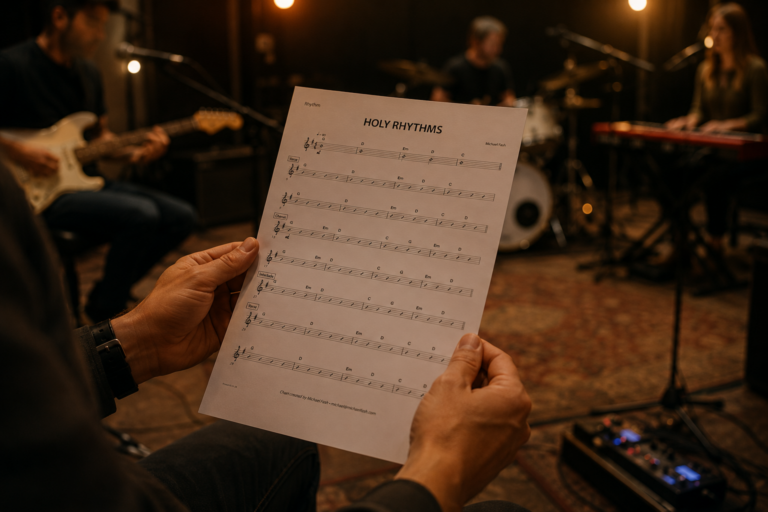
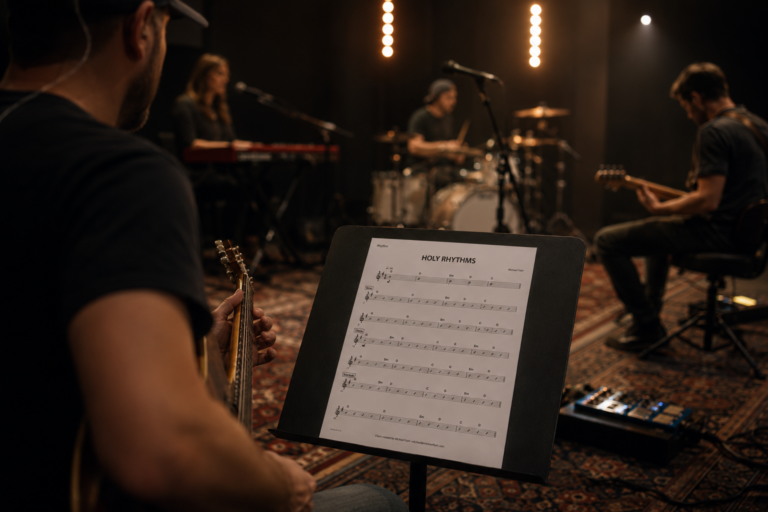
A rhythm chart communicates two things explicitly: chords and rhythm.
The chords are written out by name — G, C, Em, D — just like a chord chart. No translation required. No numbers to decode. What you see is what you play.
The rhythm is written out precisely — exact beat placement of every chord change, every rhythmic figure, every unison hit. Nothing is left to interpretation. The whole band reads the same information and plays from the same page, literally.
That combination — explicit chords and explicit rhythm — is what makes rhythm charts for worship musicians the most complete notation tool available. Every other chart type requires the musician to fill in gaps. Chord charts leave timing to interpretation. Lead sheets leave rhythm open to interpretation despite offering some timing precision. Nashville Numbers leave chord translation to the musician.
Rhythm charts leave nothing to guesswork.
And here’s something worth noting: a rhythm chart works whether you know the song or not. You can pick up a rhythm chart for a song you’ve never heard, count yourself in, and play it with your band — together, precisely, first time through. No other chart type can make that claim as confidently.
That doesn’t make rhythm charts the only tool. The Nashville Number System has a legitimate place in worship music, particularly for simple songs where key flexibility matters. But for a worship musician who needs to communicate musical expectations completely and precisely — for any song, at any complexity level — rhythm charts are the most comprehensive solution.
Which One Is Right for Your Worship Team?
The honest answer is that it depends — on your team’s experience level, the complexity of your songs, and how much precision you need.
Chord charts work fine for simple songs your band already knows well. As a cheat sheet, they’re adequate. As a communication tool for unfamiliar songs, they’re limited.
Lead sheets offer a modest step up in timing precision but add information most band members don’t need. They’re not a significant upgrade for a typical worship band.
The Nashville Number System is excellent shorthand for experienced musicians playing straightforward songs, especially when key flexibility matters. It has a real place in worship music. But it becomes more trouble than it’s worth with complexity and still doesn’t solve the rhythm problem.
Rhythm charts are the right tool when precision matters — when songs are complex, when your band needs a shared language for timing and rhythm, when you want your first run-through to sound like a band rather than a rehearsal. Which, in a contemporary worship setting, is most of the time.
A worship musician who understands all of these tools is genuinely well equipped to serve any team in any context.
The Right Music Charts for Worship Musicians
Most worship musicians never think beyond the chord chart they were handed at their first rehearsal. Understanding the full landscape of music charts is a mark of a serious, prepared musician — someone who takes their craft and their calling seriously.
If you’re ready to take the next step toward the most complete chart tool available, rhythm charts are where that journey leads. The Reading Rhythm Charts course at WorshipBandTraining.com is built specifically for working worship musicians — practical, straightforward, and free of unnecessary theory. This video series will help you have everything you need to read a rhythm chart with confidence.