How Reading Music Makes You a Better Worship Musician
For most worship musicians, reading music was never part of the plan. You picked up your instrument, learned your chords, developed your ear, and found your place on a worship team. That path works. Millions of musicians have walked it. But reading music as a worship musician — even at a basic, practical level — changes what’s possible for you. Not by making you more musical (you already are musical), but by making you more prepared, more valuable, and more effective in the room where it counts.
Here’s what that actually looks like.
What Reading Music Means for a Worship Musician
Let’s clear something up first. Reading music doesn’t mean mastering a grand staff, memorizing key signatures, or sight-reading orchestral scores at tempo. That’s a different skill set — one that takes years to develop and isn’t what your worship team needs from you.
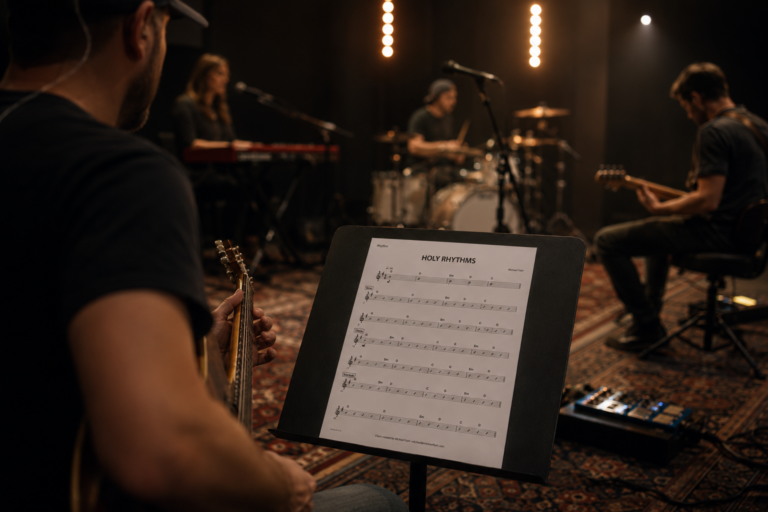
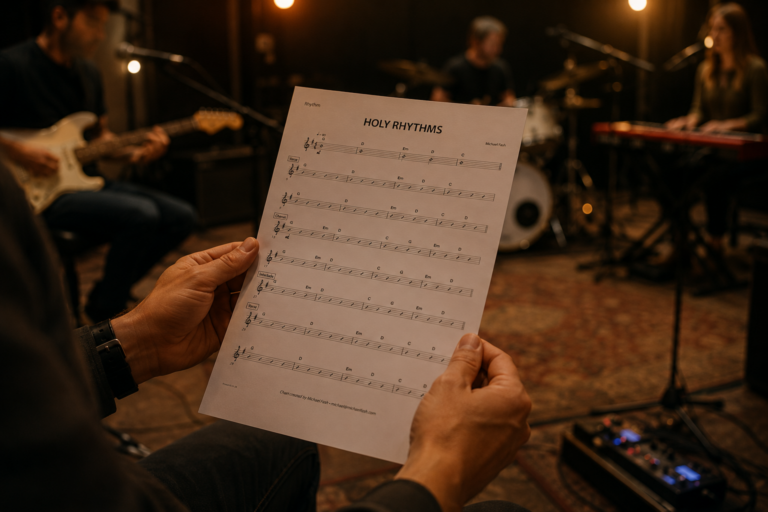
For a worship musician, reading music means understanding rhythm charts. It means knowing what a time signature tells you, what note values look like and how long they last, what the difference is between a stemless slash and specific rhythmic notation. It means being able to pick up a chart for a song you’ve never heard and know what to play and when.
That’s a modest, achievable skill set. Most working worship musicians can develop it in a matter of weeks. It doesn’t replace your ear — it works alongside it.
Reading Music Makes You More Prepared
When you can read a rhythm chart, rehearsal preparation becomes something you can actually do.
Before reading music as a worship musician was part of your toolkit, preparation meant listening to a recording and hoping you’d absorbed enough. That works for songs you know well. For new songs, it’s guesswork.
With chart reading, you can study your charts before rehearsal. You can see the song structure — where the intro ends, where the verse starts, how many measures the chorus runs. You can identify the chord changes and exactly when they happen. You can spot the rhythmic figures that the whole band needs to lock in on together.
You show up to rehearsal already knowing the song. Not just the chords — the timing, the structure, the figures. Your first run-through sounds like a band that has played the song before, because in a meaningful sense, you have.
That preparation is a form of respect — for your worship leader’s time, for your bandmates’ time, and for the calling you’ve accepted.
Reading Music Makes You More Valuable
A worship musician who can read rhythm charts is a different kind of asset to a worship team.
You can serve any team that uses charts — not just the one you’ve been on for years. You can sub for another musician who’s out sick and show up prepared, chart in hand, ready to play. You can visit another church and confidently jump in with their band. Chart reading is a universal language in contemporary worship music, and fluency in that language opens doors.
You also become the musician every worship leader wants on their team. Prepared. Precise. Reliable. Someone who doesn’t need five run-throughs to lock in a chord change because they already know where it lands. Someone who makes rehearsals shorter and Sunday mornings tighter just by showing up ready.
That’s a reputation worth building!
Reading Music Makes Your Band Tighter
Individual preparation is valuable. But the real payoff of reading music as a worship musician shows up in the room, with the band, in real time.
When everyone on the team is reading from the same chart, a shared musical language emerges. The guitarist, the keys player, the bass player — they all see the same chord change on the same beat. They hit it together. First time through.
The rhythmic figures that used to take ten repetitions to nail are written out on the chart. Everyone plays them in unison because everyone sees exactly what to play and when. The transitions that used to feel hesitant become crisp. The band stops sounding like a group of individuals playing the same song and starts sounding like a unit.
Rehearsals get shorter. The energy that used to go into figuring things out goes into the music itself — into dynamics, feel, and, ultimately, a powerful worship experience.
The congregation feels that difference, even when they can’t name it. A band that’s locked in creates space. Space for people to sing, to engage, to encounter God without the low-level distraction of a band that’s still working things out.
Reading Music Honors the Calling
There’s a bigger picture here worth naming.
Worship musicians aren’t just performers. They’re servants. The music they play is meant to create space for something that matters — for people to connect with God, to sing together, to experience community. That’s a calling worth taking seriously.
Excellence in preparation is part of taking it seriously. Showing up to rehearsal having done the work — having studied the charts, knowing the songs, ready to contribute — is an act of service to your team and to your congregation.
Reading music as a worship musician is one of the most practical ways to raise your level of preparation. It’s not about impressing anyone. It’s about being ready to do the job well.
The Next Step
Reading music won’t make you more musical. You already bring that. What it will do is make everything you already have more effective — more prepared, more precise, more useful to the people around you.
The Reading Rhythm Charts course at WorshipBandTraining.com is the most direct path to that skill for a working worship musician. It’s practical, straightforward, and built specifically for musicians who play by ear and want to add one powerful tool to their toolkit. After going through this video series, you’ll have everything you need to read a rhythm chart with confidence.