Worship Band Unity — Why It Isn’t Just About Talent
Walk into any church on a Sunday morning and you might be able to feel the difference between a band that’s locked in and one that isn’t. It’s not always about talent. Some of the loosest bands are full of capable musicians. Some of the tightest bands have players who would never describe themselves as exceptional.
Worship band unity is the variable that separates them. And unlike talent, unity is something you build — deliberately, consistently, as a team. Here’s what that actually looks like.
Talent Is Necessary But Not Sufficient
Nobody is arguing that musicianship doesn’t matter. It does. You need to know your instrument, know your chords, and know how to play in a group setting. That foundation is non-negotiable.
But five talented musicians playing independently don’t automatically sound like a unified band. Talent gets each person to a certain level. It doesn’t automatically coordinate them.
Think about what happens when a talented band is loose. The chord changes land at slightly different times. The transitions feel hesitant. The rhythmic figures that should hit together are staggered. Everyone is playing well — but not together. The result is a band that sounds capable but unfinished.
The missing ingredient isn’t more talent. It’s something that talent alone can’t produce.
Worship Band Unity Starts Before Rehearsal
The most unified worship bands share a discipline that has nothing to do with natural ability: they show up prepared.
Preparation means listening to the songs on the set list before rehearsal. It means knowing the song structure — where the intro ends, where the verse starts, how many times the chorus repeats. It means having a sense of the chord changes and the general feel of each song before you walk in the door.
When everyone arrives having done that work, rehearsal changes character entirely. Instead of spending the first run-through figuring out what happens when, the band can use that time to refine what they already know. Dynamics. Feel. Transitions. The details that make a song come alive.
Rehearsal should build on preparation — not replace it. That’s a discipline, not a talent. Any musician at any skill level can choose to show up ready.
A Shared Musical Language
Even well-prepared musicians can struggle with unity if they’re working from different information.
If the guitarist has heard one recording of a song and the keys player has heard a different arrangement, they may have different chord changes in their heads. If the bass player learned the song from a chord chart that doesn’t show exact timing, they may be placing changes differently than everyone else — not because they’re unprepared, but because their source of information left too much to interpretation.
Worship band unity requires that everyone is working from the same map. That often means a consistent chart system — something that communicates the same information to every musician in the room.
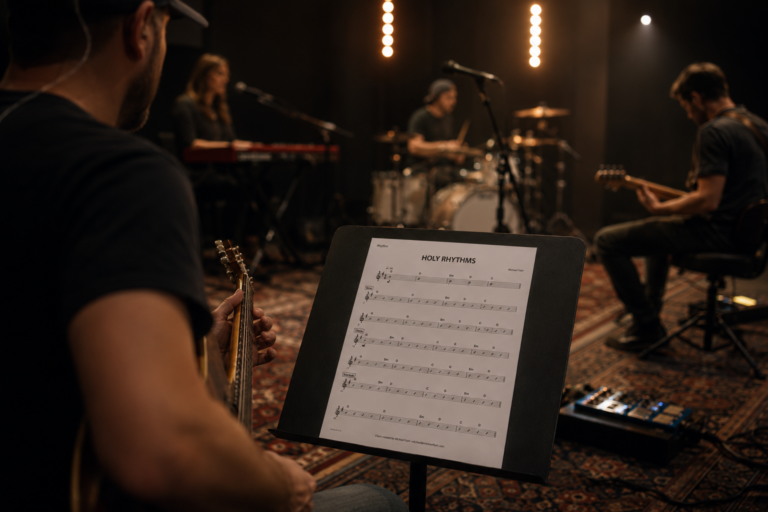
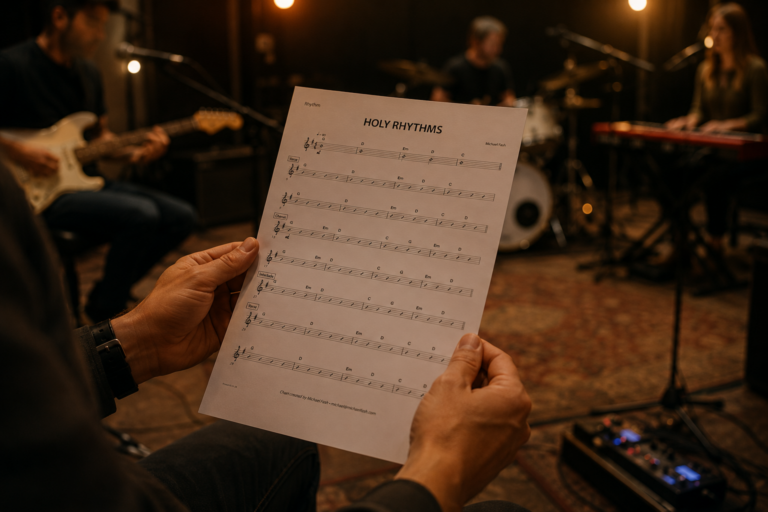
There are several ways to get there. Chord charts, Nashville Number charts, and rhythm charts all serve this function to varying degrees. Rhythm charts do it most completely, since they communicate both chords and exact timing explicitly. But the specific tool matters less than the commitment to using a shared one consistently.
Communication and Trust in the Room
Preparation and shared charts get you most of the way there. The last piece is what happens in real time, with the band, in the moment.
Unified bands listen as much as they play. Every musician is tracking what’s happening around them — watching the worship leader, hearing the drummer, feeling the dynamic shifts. They adjust in real time, not because they were told to, but because they’re paying attention.
Musical humility plays a role here too. Not every musician needs to fill every moment. Some of the most powerful worship music happens in the spaces — when a guitarist lays back, when a keys player drops to a pad, when the bass simplifies to let the vocal carry the room. Unity sometimes means getting out of the way.
Trust is the foundation of all of it. When you trust that your bandmates are prepared, that they’re listening, that they’ll hold their part — you can focus on your own playing rather than compensating for gaps. That trust is built over time, through consistent preparation and consistent attentiveness.
Unity Serves Something Bigger
It’s worth stepping back and naming why all of this matters.
Worship band unity isn’t about sounding impressive. It isn’t about musical achievement for its own sake. It’s about creating space — for the congregation to sing, to engage, to encounter God without distraction.
A band that’s locked in does that naturally. When the transitions are crisp, when the changes land together, when the music breathes and flows — people can lean into worship rather than being pulled out of it by something that feels off.
The congregation may not be able to identify what’s wrong when a band is loose. But they feel it. And they feel the difference when a band is unified. That feeling — that sense of being carried by the music into something larger — is what you’re working toward.
It’s worth the preparation. It’s worth the discipline. It’s worth the humility.
The Choice to Unify
Worship band unity is a choice — made individually and collectively, before rehearsal and in the room.
It starts with showing up prepared. It grows through shared language and shared information. It deepens through listening, trust, and musical humility. And it serves something that matters more than any of the musicians in the room.
Your band’s unity level isn’t fixed. It’s a product of the habits and choices your team makes every week. The good news is that every one of those habits is learnable, regardless of talent level.
If adding chart reading to your preparation toolkit is a next step you want to take, the Reading Rhythm Charts course at WorshipBandTraining.com is a practical place to start — six short videos built specifically for working worship musicians.