What Is a Rhythm Chart and Why Does Your Worship Band Need One?
If you’ve spent time around professional musicians, you might have heard the term rhythm chart. Maybe you’ve seen one. Maybe you’ve wondered what is a rhythm chart exactly, and whether it’s worth the trouble to learn.
It is. Here’s what you need to know.
What Is a Rhythm Chart?
The simplest way to describe a rhythm chart is this: it’s a chord chart that also tells you when.
A standard chord chart shows you what chords to play and roughly where they land with the lyrics. That’s useful. But unless you’re already very familiar with the song, it leaves the timing up to interpretation — and in a band setting, five musicians interpreting timing five different ways is a problem.
A rhythm chart solves that. Every chord change lands on a specific beat. Every rhythmic figure is written out. The whole band reads the same information and plays from the same page — literally.
What You’ll Find on a Rhythm Chart
If you picked up a rhythm chart for the first time, here’s what you’d see:
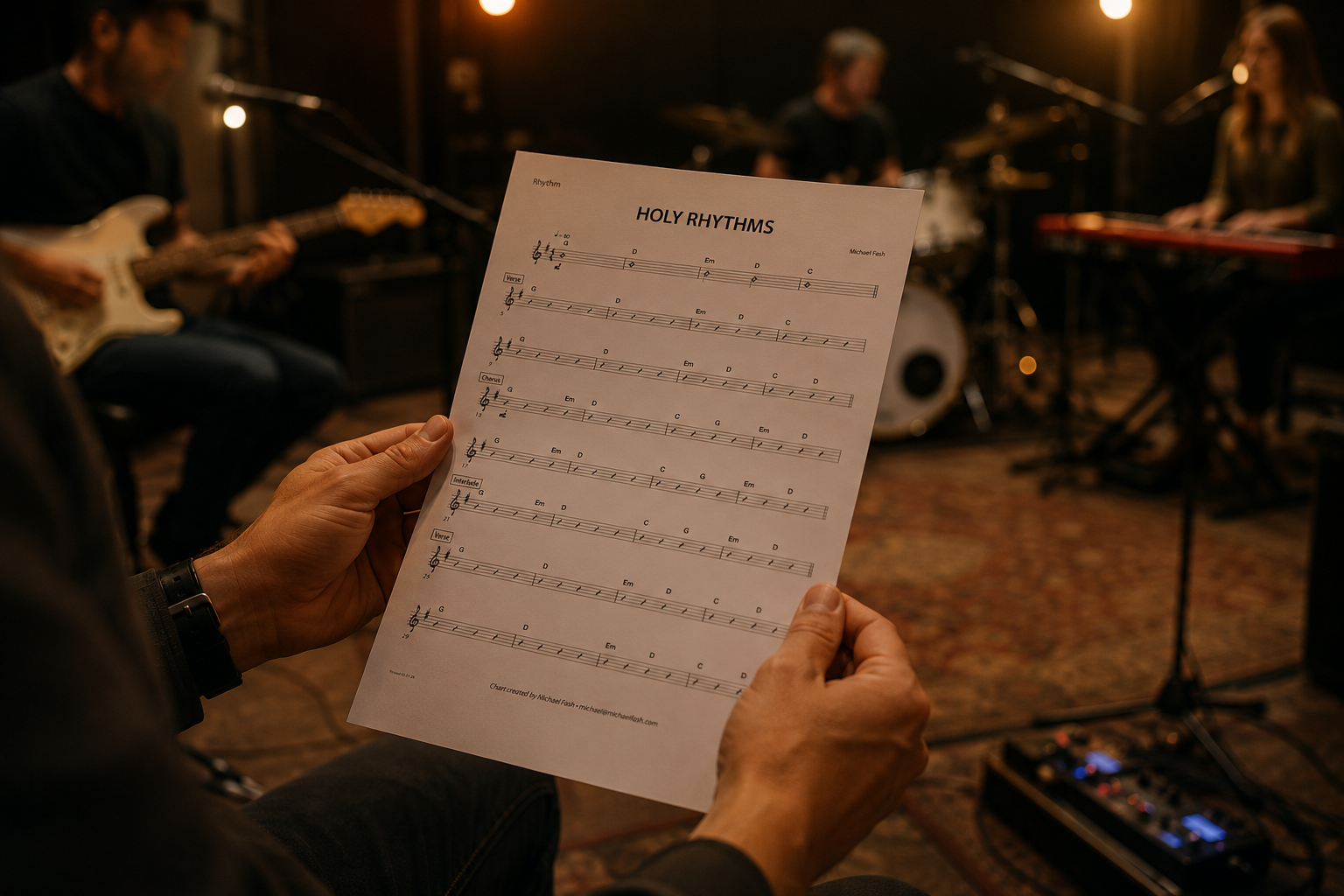
Bar lines and measures. Vertical lines divide the music into equal chunks called measures. Each measure contains a set number of beats — usually four. Bar lines keep everyone oriented in the same place in the music at the same time.
Chord symbols. Just like a chord chart, the chords are labeled — for example: G, C, Em, D. You already know how to read these.
Slashes. Simple diagonal lines that fill a measure. They tell you a chord is being played but leave the specific rhythm up to you. You’re free to interpret the groove, the feel, the strumming pattern. The chart trusts your musicianship.
Rhythmic notation. When the whole band needs to lock in on a specific rhythm — a punchy chorus figure, a signature hit, a unison stab — it’s written out precisely. These are the moments when everyone plays exactly what’s on the page, together.
Section labels. Intro, Verse, Chorus, Bridge, Tag. The structure of the song is clearly marked so you always know where you are and what’s coming next.
That’s it. No grand staff. No complex notation. Just the information a working worship musician actually needs.
How It Differs From a Chord Chart
The difference comes down to one word: precision.
A chord chart gives you the what. A rhythm chart gives you the what and the when.
Everything else stays the same — the chords, the song structure, the familiar layout. A rhythm chart just adds a layer of information that makes the whole band more precise, more unified, and more musical.
Who Uses Rhythm Charts
Rhythm charts aren’t a new invention. They’ve been standard in professional settings for decades.
Session musicians in recording studios use them. Touring bands use them. Broadway pit orchestras use them. Any time a group of musicians needs to play together with precision — on short rehearsal time, with high stakes — rhythm charts are how it gets done.
Contemporary worship music has been moving in this direction for years. As production values in church music have risen, and as worship teams have gotten more serious about musicianship, rhythm charts have become increasingly common. Many churches that work from sites like PraiseCharts already have access to rhythm charts for the songs they’re playing.
If you’re not using them yet, you’re not behind — but you’re missing a tool that a lot of serious worship bands have already adopted.
Do You Need to Read Music to Use One?
No.
This is the question that stops most worship musicians from exploring rhythm charts, and the answer is simpler than people expect.
Reading a rhythm chart doesn’t require you to read notes on a staff. It doesn’t require formal music training. It requires understanding a handful of symbols and concepts — beat counting, note values, a few basic rhythmic figures — and then practicing until it becomes second nature.
Most worship musicians who commit to learning it are reading basic rhythm charts within a few weeks. The learning curve is real but it’s not steep.
What you need is a clear, practical introduction — one that meets you where you are and doesn’t bury you in theory you’ll never use.
The Bridge Between Good Enough and Locked In
A chord chart will get your band through a song. A rhythm chart will get your band together on a song — first time through, every time.
That difference matters. It matters for your rehearsals, which get shorter and more productive. It matters for your Sunday morning, which gets tighter and more confident. And it matters for your congregation, who feel the difference even when they can’t explain it.
The Reading Rhythm Charts course at WorshipBandTraining.com is designed to get you there. It’s built specifically for worship musicians — practical, straightforward, and free of unnecessary theory. Six short videos and you’ll have everything you need to read a rhythm chart with confidence.