Why Your Chord Chart Isn’t Enough (And What to Do About It)
It’s Sunday morning. Rehearsal starts in twenty minutes. You’ve been through the song list, you know your chords, and you feel ready.
But somewhere in the first run-through, something feels off. The transitions are a little ragged. The guitarist changes on beat one. The keys player changes on beat three. The bass player is somewhere in the middle. Nobody’s wrong, exactly — but nobody’s together, either.
You all had the same chord chart. So what’s the problem?
What Chord Charts Do Well
Let’s give chord charts their due. They’re simple, they’re widely used, and they work. A chord chart tells you what chords to play and gives you a rough sense of where they fall in the song — usually tied to lyrics so you can see the general shape of things.
For a musician who already knows a song well, a chord chart is often all they need. It’s a quick reference, a memory aid, a map of the harmony.
And for that purpose, chord charts are genuinely fine.
What Chord Charts Don’t Tell You
Here’s where things get tricky. A chord chart tells you roughly what to play, but it can’t tell you exactly when to play it.
Look at a typical chord chart line. You see a G chord sitting above the word “amazing.” But does that G land on beat one? Beat three? On the “and” of two? Is it syncopated — hitting just before the beat for that little forward push that makes the song feel alive?
The chart doesn’t say. It can’t say. That’s not what it’s designed to do.
The same goes for rhythmic hits — those moments when the whole band locks in together on a specific rhythm. The punchy figure that defines the chorus. The dramatic pause before the bridge. The unison stab that lands on beat two. None of that is in a chord chart.
If you already know the song — if you’ve heard it dozens of times, if it’s in your bones — you can fill in those gaps. But if the song is new, or if your band members have different versions of it in their heads, you’re all guessing. And you’re probably guessing differently.
The Real Cost of Guessing
Here’s what guessing looks like in rehearsal.
You play through the song once. The chords are in the right ballpark, but the timing is off. You play it again. It’s getting closer, but the bass and guitar are still changing at different moments. Your worship leader stops you: “Let’s make sure we all hit that change together.”
Third time. Fourth time. Fifteen minutes later, you’ve finally got it — not because anyone read anything, but because you drilled it again and again until it stuck.
Multiply that by five or six songs every week. That’s hours of rehearsal time spent just figuring out when things happen.
But there’s a cost beyond rehearsal time. The congregation feels it too — even if they can’t name it. When a band isn’t locked in, when transitions feel hesitant, when the groove is loose, something is missing from the room. The music that’s meant to create space for worship is instead creating a low-level distraction. People are pulled out of the moment, even slightly, even subconsciously.
The worship experience is missing out on what it could be.
What Rhythm Charts Add
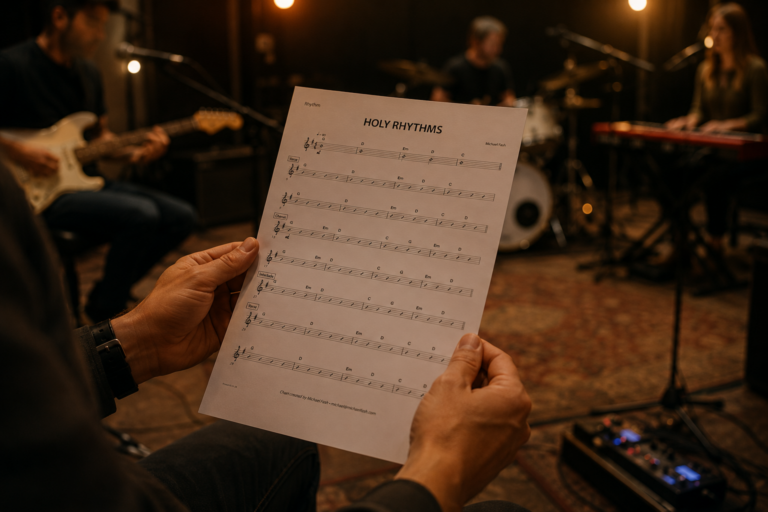
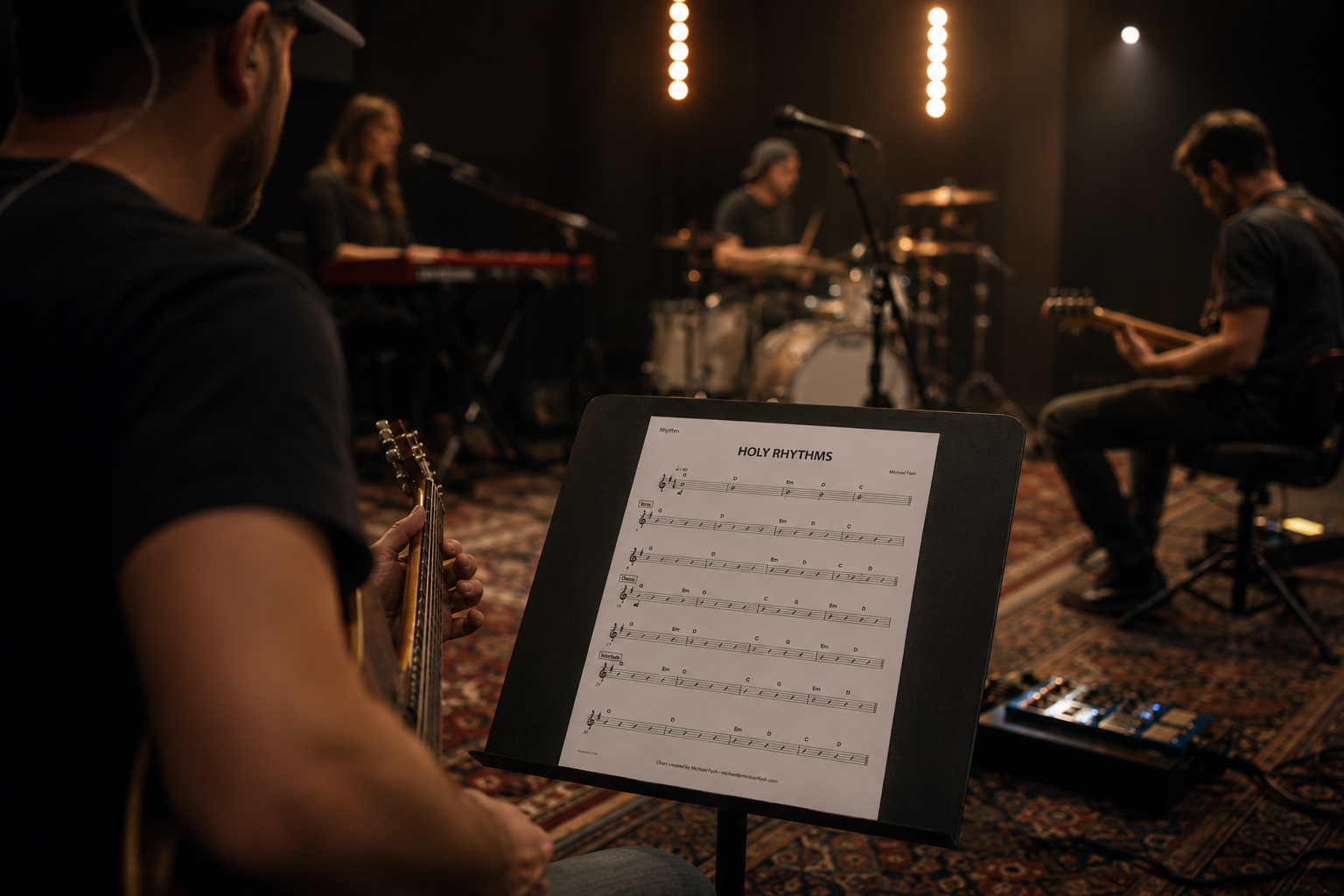
A rhythm chart gives you everything a chord chart gives you — and then adds the one thing a chord chart can’t: the exact timing of when things happen.
With a rhythm chart, every chord change is placed on a specific beat. Everyone in the band sees the same information. The guitarist, the keys player, the bass player — they all know that the chord changes on beat three of measure two, not beat one, not beat four. They hit it together. First time through.
Rhythmic figures are written out too. When the chorus calls for a specific punchy pattern, it’s right there on the chart. No guessing. No drilling it ten times until everyone happens to land in the same place.
The song structure is clearly mapped — intro, verse, chorus, bridge, tag. You can see the whole shape of the song before you play a single note.
The result? Your first run-through is already 80% there. Your second run-through feels like a band. Your rehearsal time drops dramatically, and the energy you save goes into the music itself — into dynamics, into feel, into worship.
Rhythm Charts for Worship Musicians — The Upgrade Your Band Has Been Missing
Let’s be direct: rhythm charts are a superior way to communicate music to a band. They don’t change the underlying song — the chords are the same, the structure is the same — but they convey what to play with a precision that a simple chord chart can’t match.
That’s not a total knock on chord charts. They served a purpose. But if your band has been struggling with timing, ragged transitions, or hours of repetitive rehearsal, the chord chart is the reason — and a rhythm chart for worship musicians is the solution.
The good news is that reading rhythm charts for worship musicians is not as complicated as it might sound. You don’t need a music degree. You don’t need years of formal training. You need to understand a few basic concepts, and then you need a little practice.
That’s exactly what the Reading Rhythm Charts course at WorshipBandTraining.com is designed to teach. It’s built for working worship musicians — people who play by ear, who know their chords, who love worship, and who are ready to take their playing to the next level.
Your chord chart got you this far. It’s time for something better.